
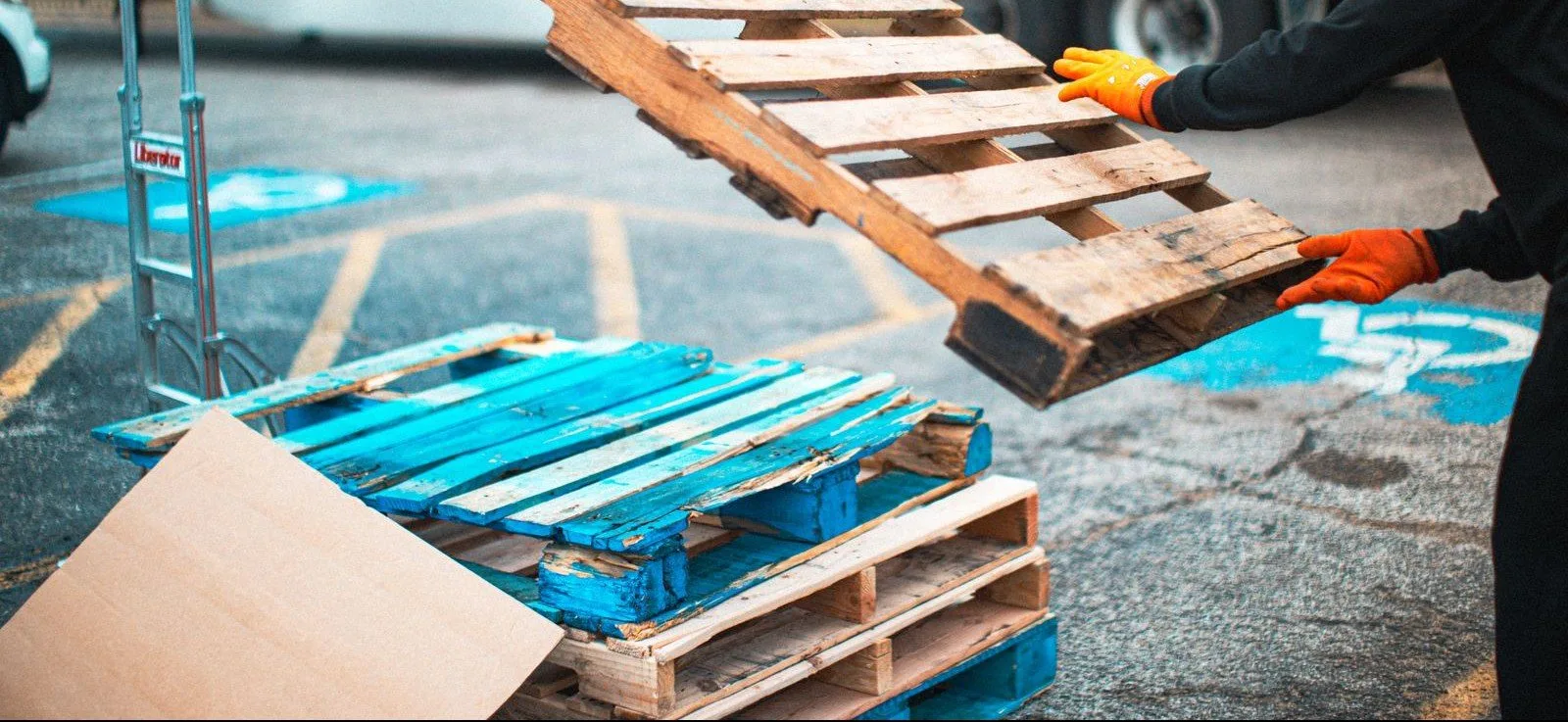
Pallet stacking is a separate position, even if no one calls it that
Calculating the cost of a pallet usually starts with timber and the pallet assembler. However, before a pallet leaves the plant, it also goes to someone who receives it from the table or machine, stacks them into pallet stacks, and prepares the stack for forklift removal. In the article on the real costs of manual pallet production, we listed this person among those through whose hands the pallet passes, although they do not appear as its cost in the records.
With several hundred pallets a day, stacking can take up a full-time position. Our observations show that in smaller plants, the pallet assemblers do it themselves, between one pallet and another, and then the cost doesn't disappear; it's hidden in their work pace. In both cases, it's worth calculating it separately, because only then do you know what to compare a potential machine with.
How much does it cost to stack one pallet? Around one zloty
For the calculation, we take the same plant that serves as a reference point throughout the series: 600 block pallets per shift, which is approximately 12,600 pallets per month with 21 working days. The full cost of one employee, including a salary above the minimum wage, employer's contributions, clothing, recruitment, and onboarding, amounts to, according to our calculations, PLN 9,720 to PLN 13,270 per month, averaging around PLN 11,740. This also includes covering holidays and sick leave, as the stack must continue to grow even when the employee is absent. For agency staff cover, this is approximately PLN 1,000 per month per position.
The path to the result is as follows: PLN 11,740 in employee cost plus approximately PLN 1,000 to cover absences totals PLN 12,740 per month. Divided by 12,600 pallets, this comes to approximately PLN 1.01 per stacked pallet. In the cheapest scenario, it's around 85 groszy, and in the most expensive, around PLN 1.13. Annually, one position per shift costs from approximately PLN 129,000 to PLN 171,000, averaging around PLN 153,000.
These figures are based on 2026 rates and the assumptions from our previous article. The method remains the same, but it's worth substituting your own figures: salary, number of pallets, and how holidays are covered in your plant.
Approximately fifteen tonnes per shift
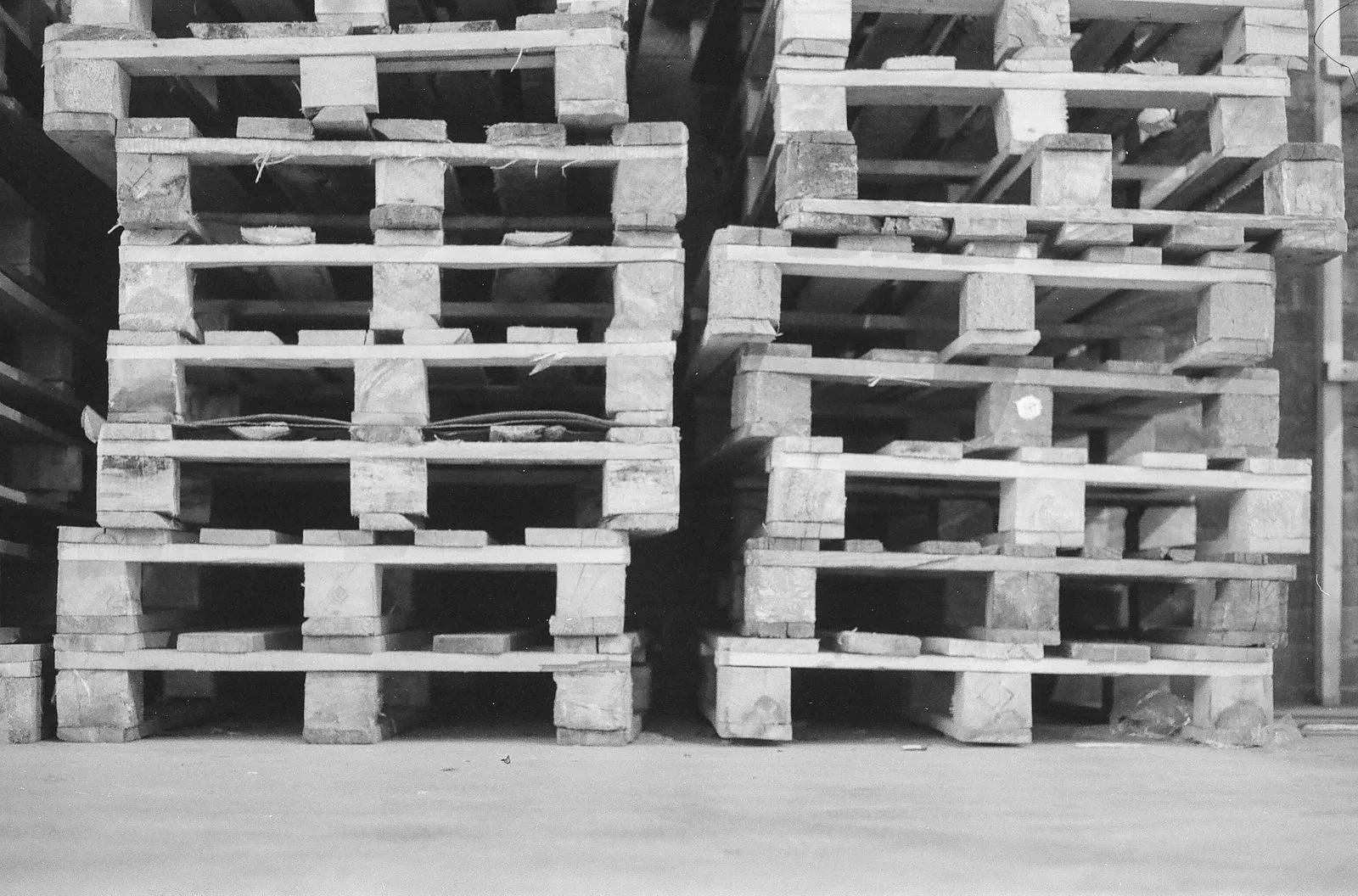
A EUR pallet measuring 1200 × 800 × 144 mm weighs approximately 25 kg, depending on timber species and moisture content. With 600 pallets per shift, the person stacking therefore lifts approximately 15 tonnes. Assuming eight hours without breaks, another pallet appears approximately every 48 seconds, and in practice, after deducting breaks, even more frequently. If the stack is approximately 1.9 m high, as with a stacker, that's thirteen pallets, so all upper layers must be lifted above shoulder height.
I remember a position during the commissioning of a nailing machine at one of our customer's sites. Behind the machine stood a person whose sole task was to receive finished pallets and stack them into pallet stacks. After the first hour, he was already soaked with sweat, and the shift was just getting started. Such a pace can be maintained for some time, but it decreases with each hour, and breaks lengthen.
What regulations say about manual pallet lifting
The rules are defined by the regulation on health and safety at work for manual handling operations. For continuous work, a man may lift and carry objects weighing up to 30 kg, and a woman up to 12 kg. A separate, lower limit applies to lifting above shoulder height: 21 kg for men and 8 kg for women for continuous work. A pallet weighing approximately 25 kg therefore falls within the general limit for men, but for the upper layers of the stack, it exceeds this lower threshold.
This does not mean that manual stacking is prohibited. It means it needs to be reconsidered: for example, setting a lower stack height, planning breaks, or rotating personnel in this position. It's also worth remembering the broader context. According to ZUS (Social Insurance Institution), musculoskeletal disorders accounted for 42.4 million days of sick leave in Poland in 2025. This data is for the entire economy, not just the pallet industry, but it clearly shows that lifting has its cost even when it's not visible on the payroll.
Check how much stacking costs in your plant →
Stacker and robot: the same stack without lifting
On pallet production lines, stacking can be taken over by a stacker. An IMH stacker, according to the manufacturer's datasheet, performs up to five cycles per minute, builds a stack with a recommended height of approximately 1.95 m, and automatically pushes out the finished stack for collection. With 600 pallets per shift, it therefore uses only a fraction of its capabilities, as five cycles per minute theoretically equates to 2,400 units within eight hours.
The energy cost here is low. A stacker has 7.5 kW of power. If it worked the entire shift at full power, it would consume 60 kWh, which at a price of PLN 1.10 to PLN 1.30 per kWh yields PLN 66 to PLN 78, or approximately 11 to 13 groszy per pallet for 600 units. This is the upper limit, as the machine does not operate at full load continuously.
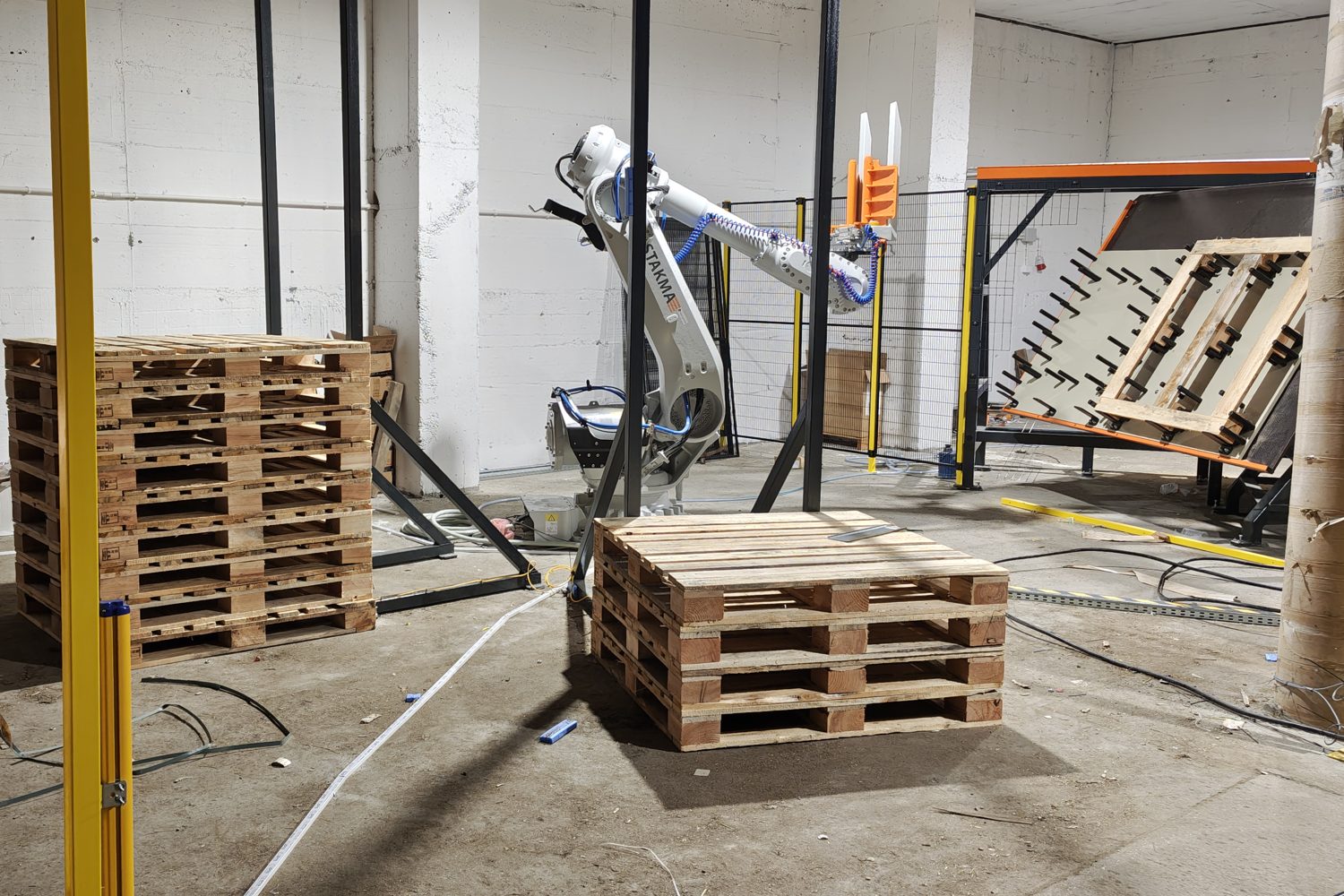
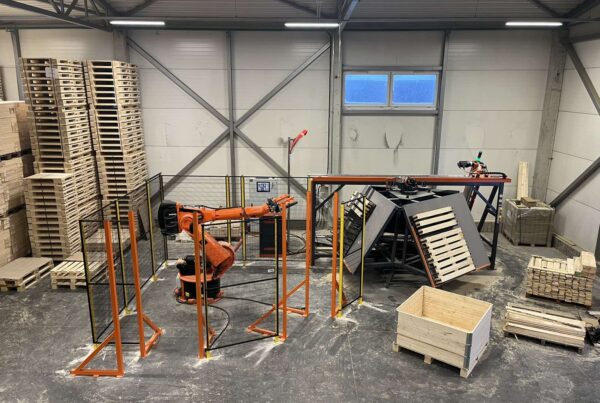
The second option is a robot. In one of our implementations in the Pomeranian Voivodeship, an ABB robot receives a finished pallet from the PALLETSTAR line and stacks it into a pallet stack, with one operator working at the line. The robot operates in a fenced-off cell, which, according to the STAKMA brochure, occupies an area of approximately 6 by 5 metres, so space needs to be planned for it.
When automatic stacking pays off fastest
A stacker or robot pays for itself fastest where pallets exit the line via a conveyor, and a full-time position is dedicated to stacking on each shift. In such cases, the entire cost of the position from the calculations above transfers to the machine. In a plant that nails pallets at several separate tables, we usually plan stacking automation together with the line. Non-standard pallets, whose dimensions change every more than ten units, can still be stacked manually, while the machine takes over repeatable formats that yield the largest volume.
The cost of the position itself is not the entire saving, however. From the annual stacking cost, you must subtract what the machine consumes and requires: electricity, maintenance, and parts. Only this difference, divided by the price of the device with installation, shows the real payback period. For a stacker, electricity alone is at the upper limit of approximately 11 to 13 groszy per pallet, which is approximately PLN 17,000 to PLN 20,000 annually per shift. The cost of maintenance depends on the configuration, which is why we calculate it for a specific set of machines.
In this calculation, it's worth remembering the other side. Automatic stacking does not get tired during the shift, so the end of the line maintains the same pace from the first to the last hour. The person who previously stacked pallets can move on to tasks that increase the efficiency of the entire production, for example, feeding material to the line or quality control.
Do you manage production, but the board decides on purchases? The two tables below are ready material for a discussion with your boss: the cost of the stacking position per pallet and annually, the mass lifted per shift, and a comparison of manual work, a stacker, and a robot. Use the figures from your plant: salary, number of pallets per shift, and number of shifts. In a free consultation, we will help prepare such a comparison for your line.
Manually, stacker, or robot? A comparison
Below, we compare three methods of stacking pallets at the end of production. Machine data comes from manufacturers' datasheets and our implementation, and the purchase price is only provided for a specific configuration, as it depends on the line, pallet dimensions, and available space in the hall.
| Manually | IMH stacker | ABB robot | |
|---|---|---|---|
| Who stacks | employee | machine at the end of the line | robot in a fenced-off cell |
| Pace | approx. 48 s per pallet for 600 per shift | up to 5 cycles per minute (according to manufacturer) | PALLETSTAR line pace, 400-600 pallets per shift (according to manufacturer) |
| Mass lifted by a person per shift | approx. 15 t | none | none |
| Requirements | space for stacks | line conveyor | machine with robot occupies approx. 6 × 5 m (according to STAKMA) |
| Electricity per pallet | none | 11-13 groszy (upper limit) | depending on the configuration |
| Operators | full-time on each shift, approximately PLN 1.01 per pallet | supervised by the line operator | supervised by the line operator |
Manual pallet stacking in numbers
| Position (assuming 600 pallets per shift) | Minimum | Average | Maximum |
|---|---|---|---|
| Full cost of position including absence cover / month | PLN 10,720 | PLN 12,740 | PLN 14,270 |
| Cost per stacked pallet | PLN 0.85 | PLN 1.01 | PLN 1.13 |
| Annual cost, one shift | PLN 129,000 | PLN 153,000 | PLN 171,000 |
| Annual cost, two shifts | PLN 257,000 | PLN 306,000 | PLN 342,000 |
| Weight lifted per shift (approx. 25 kg pallet) | - | approx. 15 t | - |
Where to start in your own plant
Manual stacking is easy to overlook because it amounts to just one zloty per pallet. At the same time, it dictates the pace of production completion and involves people handling more than ten tonnes every day. Before deciding on a machine, it is worth calculating three figures for your own operation: how many pallets are produced per shift, how many working hours their stacking currently takes, and how high the stacks are. We start every project for our customers with these same figures, as they show whether a stacker, a robot, or for now, a better organised manual station would be more suitable. If budget is a barrier, it is worth immediately calculating a variant with leasing or with funding, which we have described in a separate article.
Sources
- Announcement of the Minister of Family, Labour and Social Policy of 11 May 2018 on the consolidated text of the regulation on health and safety at work during manual handling operations (Journal of Laws 2018 item 1139), § 13: https://eli.gov.pl/eli/DU/2018/1139/ogl
- ZUS, “Increasingly frequent and longer sick leaves”, 28.04.2026: https://www.zus.pl/-/coraz-cz%C4%99stsze-i-d%C5%82u%C5%BCsze-zwolnienia-lekarskie
- IMH Machinery AB, IMH-S stacker datasheet (version of 27.09.2024): https://imhmachinery.se/downloads/
- Integrated Educational Platform (zpe.gov.pl), “Visualisation of transport equipment and load unit marking in 2D”: https://zpe.gov.pl/a/DHQjWhBi6 and Quivo, “Euro pallets dimensions explained”: https://quivo.co/en/euro-pallets-dimensions-explained/
- MDP Serwis, “What are the real costs of manual pallet production?”: employee cost, absence cover, energy prices
The cost of the position and the implementation example come from our calculations and projects we have worked on.
Step 1: free initial consultation. We discuss how many pallets you produce per shift, their dimensions, and how you currently retrieve them from the table or line.
Step 2: technical visit. If the project makes sense, we visit to check the space for a stacker or robot cell and together calculate the payback period for the equipment.





Write a comment