
 Pallet line simulator: check output before buying machines
The line is not the sum of machines, but a queue to the slowest station
The throughput of the whole process equals the throughput of its bottleneck. This is the basic principle of Eliyahu Goldratt's Theory of Constraints, and in practice it looks like this: if one station makes 100 pallets per hour and the next 50, the whole line will produce 50. The faster station will not raise the result, it will only create a queue before the slower one. Additional work at a station that does not limit the line does not increase the output.
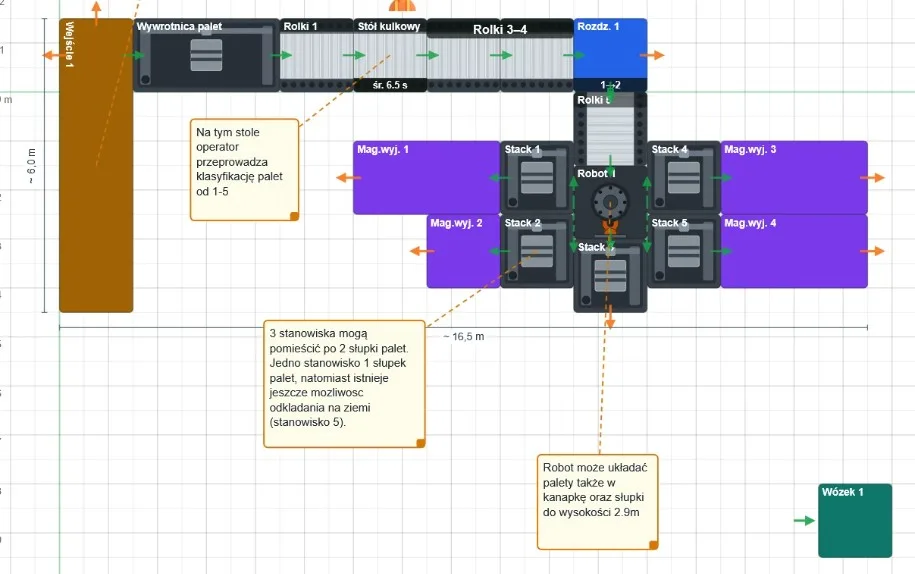
In a pallet sorting and repair line there are several such stations: a de‑stacker that dismantles stacks, repair stations, sorters that direct pallets by class, stackers, and between them roller conveyors and outfeed stores. Each has its own cycle time and each can become a bottleneck. On the shop floor this is visible immediately - pallets wait in a queue for repair, and the stacker behind it waits for pallets.
The whole system matters, not a single machine: 250, 213 and 307 pallets per hour
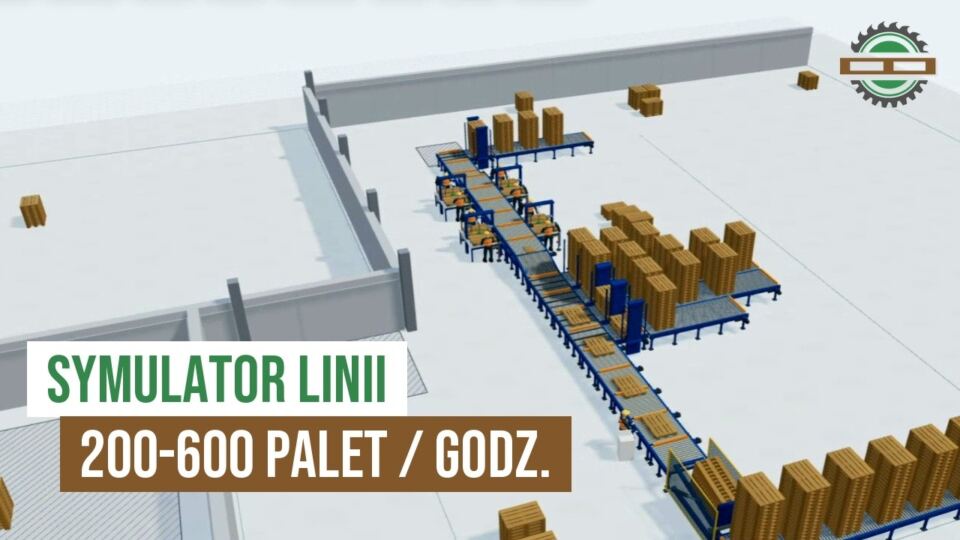
In the video we show an example sorting line in our simulator. After clicking “Simulate” the counter reads 250 pallets per hour. The screen also shows why it cannot be higher: two stackers already have 13 out of 15 pallets each, and the third only 5. The sorters direct most pallets to the two stackers, creating a queue before them.
Next we add a robot station but keep the old pallet distribution. The counter shows 213 pallets per hour because the pallets still mainly go to the same two stackers, creating a queue before them. When we change the pallet distribution to different stackers, the robot variant reaches 307 pallets per hour, the highest of all layouts. The new station demonstrates its full potential only when the rest of the line keeps up with the outfeed of pallets. Then we rotate and reposition further elements, each time restarting the simulation. It is easier to see this on screen than after installation in the hall.
Simulation - checking the layout on screen before it is built in the hall
Simulating a line layout before it is built is not our invention. In industry this is used to compare different machine arrangements and identify bottlenecks before an investment decision is made. We do it for pallets: the simulator moves pallets along conveyors at their speed and shows where queues form, i.e. which station limits the whole system. We design the line together with the customer, to his hall and his pallets, and at the end the customer views it in 3D and receives a quotation.
From our experience, a sorting line rarely has a single bottleneck machine. More often it is the repair station, where a queue builds up, or the distributors and stackers that cannot keep up with pallet classification. Therefore the simulator not only repositions machines but also reallocates pallets between stackers, exactly as shown in the video.
How many pallets will your line sort? We will simulate it before you order anything.
What the simulation cannot know
The simulator calculates flow based on the parameters you enter. It will not guess that this delivery will contain more damaged pallets than usual, that repairs will take longer, or that a stacker will be down for an hour. The result is an estimate for a well‑functioning line, so actual production will usually be lower and a safety margin must be left.
We are also honest about the second point: not every operation needs a line capable of 600 pallets per hour. We design layouts from 200 to 600, and if a plant receives 250 pallets per hour, a 600‑pallet line means money tied up in equipment that will be idle for most of the shift. Therefore we first determine how many pallets really need to be sorted, and only then select the appropriate layout.
How many pallets a better‑configured line can deliver
The catalogue will tell you how much each machine can do individually. How much they achieve together is shown only by simulation. In the video example the best variant, with a robot station, produces 307 pallets per hour, whereas the first layout yields 250. That is 57 pallets per hour more, equating to over 450 pallets in an eight‑hour shift.
Calculation: 307 - 250 = 57 pallets per hour. 57 × 8 hours = 456 pallets per shift. The calculation assumes an eight‑hour shift with no downtime, so in practice the difference will be smaller, but the order of magnitude remains.
Step 1: free initial consultation. We discuss your line: how many pallets are sorted per shift, how many classes you use and how many people work on repairs.
Step 2: simulation and technical visit. We model the line in the simulator for your hall and show the estimated capacity. If the project makes sense, we visit the plant, inspect the hall and together calculate whether the investment will pay off.
Sources
- Brainstorm, „Bottleneck - what it means and how to eliminate it”
- LeanTrix, „What is TOC? Theory of Constraints in practice”
- Y. Li, N. He, D. Z. Zhang, „Simulation Based Layout Design and Optimization for Assembly Line System”, Proceedings of the World Congress on Engineering 2019
- MDP Serwis, film „Line simulator for pallets: check capacity before buying machines”, 2026
The figures 250, 213 and 307 pallets per hour come from example line variants in our simulator shown in the video. They are our example, not market statistics.




Write a comment