
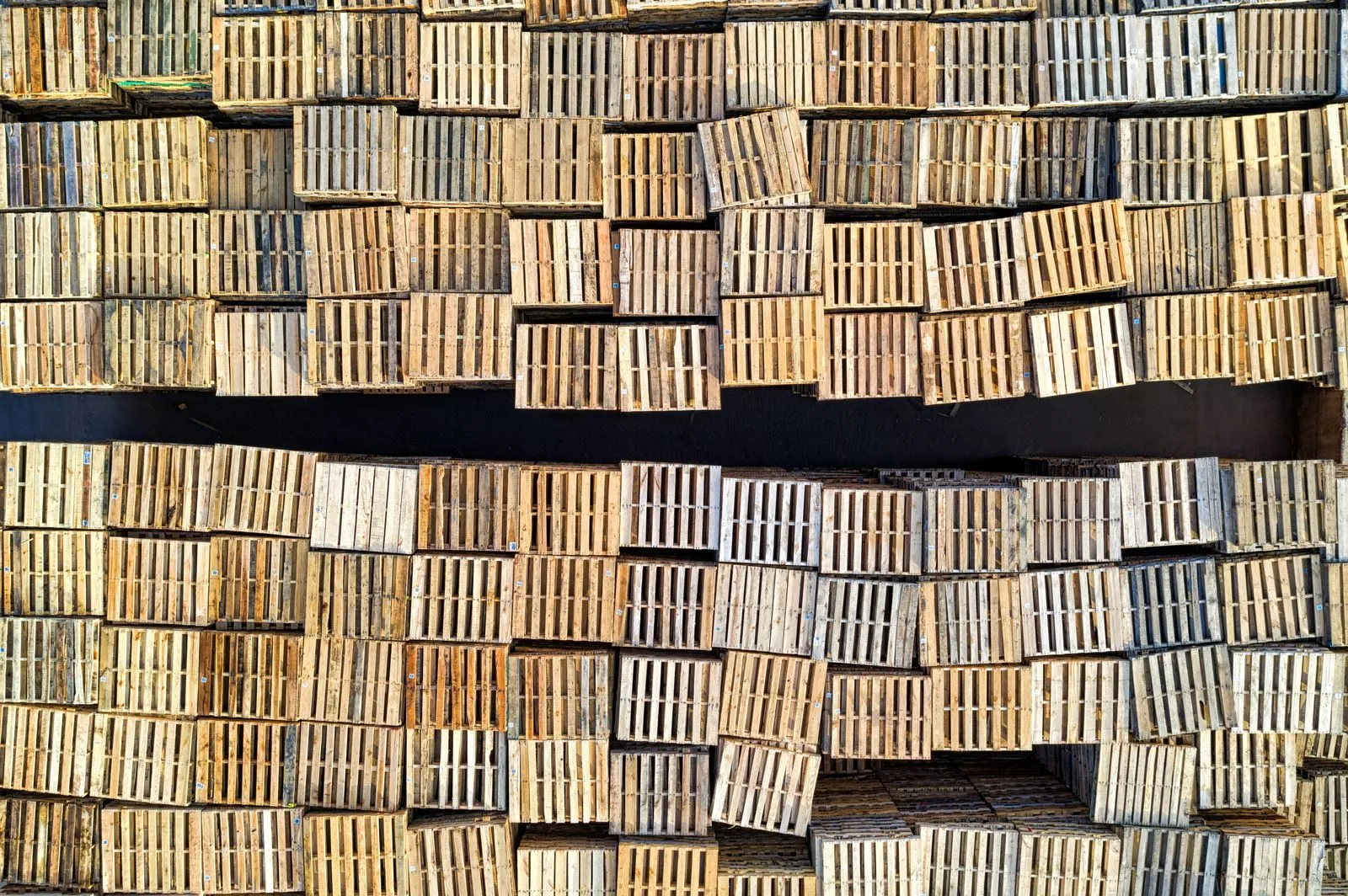
What changes on the shop floor when a line is introduced
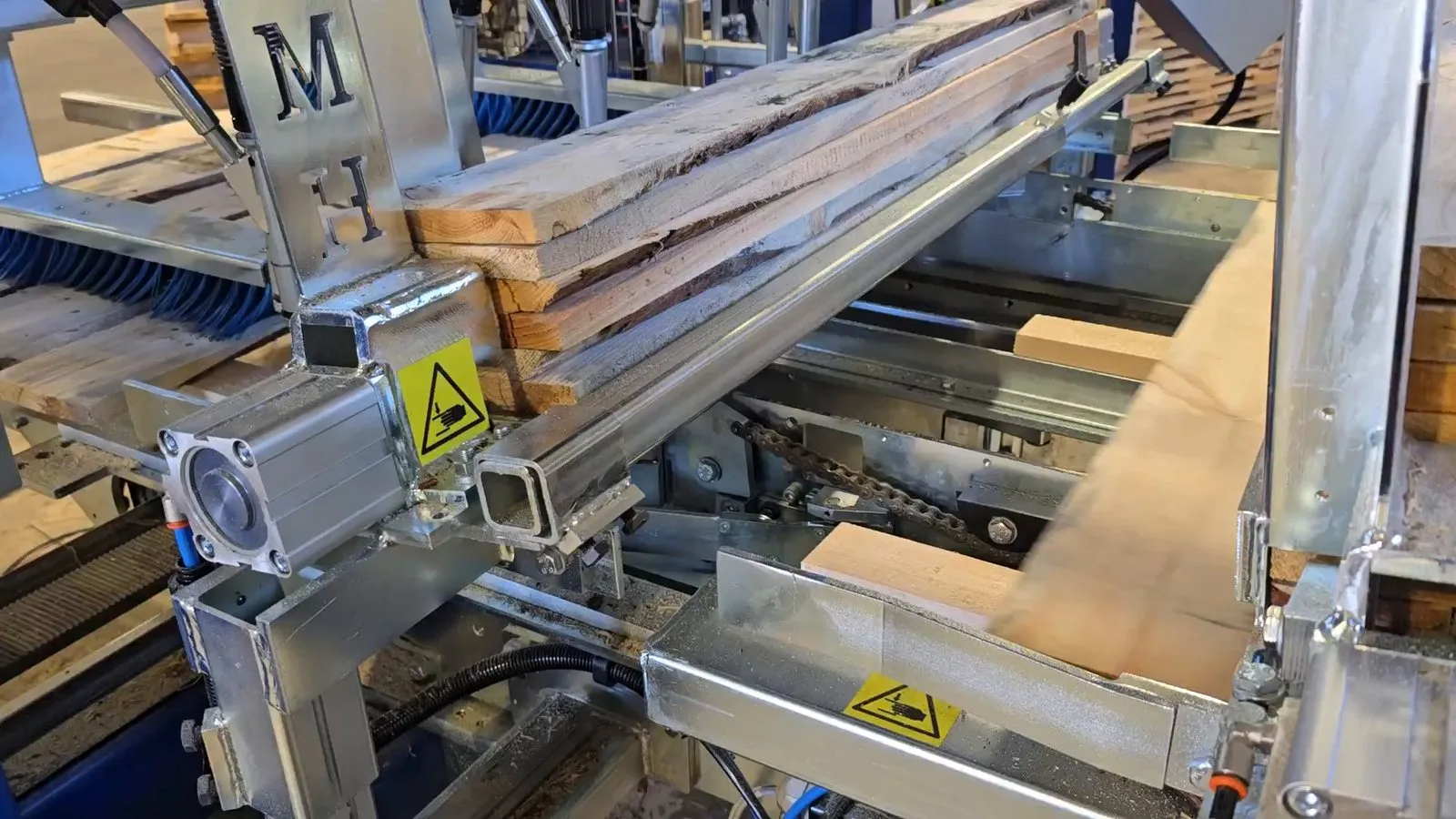
The difference is most visible in the implementation we described in the first article of the series. Before the change the plant produced manually 800‑1,000 pallets per day, and per person - including trolley work and material preparation - about 100 pallets. After organising work around the line the plant now makes an average of 1,500 pallets per day, roughly 400 per person. Not because anyone worked faster, but because machines took over part of the tasks. On the line, pallet nailing and stacking are performed by equipment, while people feed material, monitor quality and operate the control panel. Output per person therefore increases roughly four‑fold.
Assume a full cost of one employee, including holiday and sick cover, of PLN 12,740 per month, as in our article on manual production costs, and 21 working days per month. At about 100 pallets per person per working day, labour costs in the medium scenario are roughly PLN 6.07 per pallet. At about 430 pallets per person, the cost falls to around PLN 1.42. Across the whole range, from the best to the worst scenario, the difference is between roughly PLN 3.20 and PLN 6.40 per pallet, which over a month exceeds any other cost item apart from wood.
Wood is accounted for equally in both scenarios
Wood is the largest cost component of a pallet and is calculated the same way in both cases. In our calculation for a plant producing 600 pallets per block per shift, wood costs on average PLN 36.40 of the roughly PLN 45 visible pallet cost - about 80%. The price per cubic metre is identical regardless of the nailing method.
The line can, however, help reduce waste. The IMH block optimiser, according to the manufacturer, calculates the beam cut to leave as little off‑cut as possible. How much this saves in monetary terms depends on the raw material and pallet design, so we do not assume any wood savings in the comparison below. We prefer to be cautious.
Loose nails instead of collated nails
Manual nailing with pneumatic nailers requires collated nails, wire‑linked. IMH machines use loose nails, 40‑100 mm long. In our calculations this is PLN 0.99 instead of PLN 1.24 per pallet - a quarter of a zloty difference. At 31,500 pallets per month this saves about PLN 7,900.
How much the line itself costs per pallet
In our comparison we also include the cost of the line itself. In the first article of the series we stated that a complete line now approaches €800,000. Using the NBP average rate of 4.3716 PLN per euro on 20 October 2026, that is about PLN 3.5 million. We spread this cost over ten years of operation - a cautious assumption, as our used‑machine offer currently includes, among others, the IM hart R1000 line from 2009. Ten years equals roughly PLN 350,000 per year, or about PLN 29,000 per month. At 31 500 pallets this works out to PLN 0.93 per pallet.
We calculate electricity with a safety margin. Single IMH line machines are listed with a power of 7.5 kW or 15 kW. If five 15 kW machines ran a full shift at full power they would consume 600 kWh. At a price of PLN 1.10‑1.30 per kWh this is PLN 660‑780, i.e. 44‑52 pence per pallet at 1 500 units. In practice the machines do not run at full power continuously, so this is the upper bound.
Wooden pallet - manual and line: comparison on a single unit
Below we compare both options. The manual column comes from our article on manual production costs (assumption: 600 pallets per shift, medium variant). The line column is an estimate for 1 500 pallets per day, calculated using the same rates.
| Cost component per pallet | Manual (600 pallets/shift) | Line (1 500 pallets/day) |
|---|---|---|
| Timber | £36.40 | £36.40 |
| Labour with absence cover | PLN 6.50 | £1.42 |
| Nails | £1.24 (collated) | £0.99 (bulk) |
| Location (hall or tax), assumption: no change | PLN 0.90 | PLN 0.90 |
| Equipment: nailers or line amortised over 10 years | PLN 0.09 | £0.93 |
| Electricity | PLN 0.04 | up to £0.52 |
| Clothing, consumables, washing | PLN 0.05 | PLN 0.05 |
| Line service | not applicable | for configuration calculation |
| Total, excluding line service | approximately £45.20 | approximately £41.20 |
With full utilisation a pallet from the line is about four pounds cheaper. These figures are based on 2026 prices and should be recalculated with current data.
How many pallets must be produced for the line to be profitable?
Savings increase with production volume. If the line produces the same amount as manual production - 600 pallets per shift - the depreciation charge spreads over 12 600 units instead of 31 500, amounting to about £2.31 per pallet, and three operators add roughly £3.03. A line pallet then costs about £44, so the difference narrows to around one pound. Therefore we size the line to the plant’s volume: for lower output a smaller machine set or a used line, which reduces the depreciation charge, is more appropriate.
We calculate a simple pay‑back period as: line price divided by the monthly cost difference, before adding the line’s depreciation charge. With the same output as manual production the monthly saving is about £40 000, giving a pay‑back of roughly seven years. At 1 500 pallets per day the saving rises to about £152 000 per month, shortening the pay‑back to roughly two years.
| Variant | Cost per pallet excluding service | Pallets per month | Monthly difference before line depreciation | Simple line price pay‑back |
|---|---|---|---|---|
| Manually | approximately £45.20 | 12 600 | - | - |
| Line, same output (600 per shift) | approximately £44.20 | 12 600 | approximately £40 k | approximately 7 years |
| Line, full utilisation (1 500 per day) | approximately £41.20 | 31 500 | approximately £152 k | approximately 2 years |
This second option has one condition: the additional pallets must find buyers. Higher production capacity alone does not increase sales, so the starting point is the number of pallets the plant can realistically sell. The most effective solution, which is also the most flexible, is a combination: the line handles repeatable formats that generate the highest volume, while non‑standard pallets in short runs can be produced on‑site.
What is still missing from this table
A simple pay‑back period is a starting point, not a full calculation. To complete it you need to add three items. The first is service: inspections, spare parts and technician time. Its cost depends on the line configuration and the number of shifts, so we calculate it for the specific machine set.
The second is commissioning. The first weeks after start‑up are a learning phase: the team gets to know the machines and the line gradually reaches its target output. From our experience it is worth planning this period both in the order schedule and in the financial model. Ideally training for operators and support during the initial weeks are included in the offer rather than being a separate post‑installation item. The third is financing. With a lease or loan, interest is added to the line price and the monthly instalment affects cash flow in the early years, so it should be compared with the monthly cost difference shown in the table above.
How to compare it for your own operation, step by step
- Calculate how many pallets you actually sell per shift and how many you could sell if capacity were higher.
- List all personnel involved in production, not only pallet assemblers: forklift driver, block cutter, pallet stacker.
- Include the full cost of a person, covering absences, not just the salary.
- Divide the line cost by its years of operation and by the number of pallets you will actually produce on it.
- Add service costs for the specific configuration and compare both columns on a per‑pallet basis.
Calculate both options for your plant →
What this means for your plant
The line does not lower timber prices but changes the organisation of work: per employee the number of pallets handled increases several times and the cost per unit falls the more pallets are produced. Before a decision is made, it is worthwhile to carry out your own profitability analysis: enter your timber costs, staffing and the number of pallets you actually sell into the table. We prepare such a calculation with customers before selecting any line. If you manage production and the board makes the decision, the pay‑back table and the list of items outside the table provide a ready‑made framework for the manager.
Sources
- MDP Serwis, “Why companies lose money through manual pallet production - the five most common mistakes”: implementation example (800‑1000 and 1500 pallets per day, output per person), line price, loose and collated nails
- MDP Serwis, “What are the real costs of manual pallet production?”: cost of a manual pallet, employee cost, energy prices
- NBP, table A no 204/A/NBP/2026 dated 20.10.2026, average EUR rate PLN 4.3716: https://api.nbp.pl/api/exchangerates/rates/a/eur/
- IMH Machinery AB, catalogue data sheets for line machines (versions dated 27.09.2024): https://imhmachinery.se/downloads/
- MDP Serwis, used‑machinery offer: IM hart R1000 line (2009)
The calculations per pallet are our estimate based on 2026 prices, not on data from a specific customer.
Step 1: free initial consultation. We discuss how many pallets you produce and sell, what types, and how many staff are currently involved in production.
Step 2: technical visit. If the project makes sense, we come to your site, inspect the hall, power supply and material delivery, and then compare the pallet cost for both options together.




Napisz komentarz