
Before you start: where the money is in the pallet cost
We calculate on the same plant that serves as reference throughout our series: 600 pallets per block per shift, i.e. around 12 600 pallets per month. The visible cost of such a pallet is on average about £45, of which timber is about £36.40, roughly four fifths. The next item is labour, and the rest, from nails to electricity, are a few pence or pounds. We described the detailed line‑by‑line breakdown in the article on the real costs of manual pallet production.
We grouped the methods by type of benefit, as they cannot be fairly ordered by a single amount. Some increase output, others lower the cost per pallet, shorten downtime, free cash tied up in timber or make better use of fixed costs. We start with output, because everything else depends on it.
1. Output: material where it is used
In many plants we visit, the block sits at one end of the hall and the nailing table at the other. Someone moves these items, someone else waits for them. No one records this, but each pallet pays for it. Rearranging stations so that timber flows in one direction, from the yard through cutting and nailing to outfeed, requires no investment and raises output per person. The simplest start is one day of observation: how many times the same item is lifted before it becomes a pallet.
- Draw the route of a single pallet on the hall plan: from the timber yard through cutting and nailing to the outfeed point.
- Mark the spots where material returns or waits to be moved.
- First relocate the station where people stand and wait most often.
A separate case is the jigs. We have repeatedly seen whole stacks of old jigs against a wall in plants, regarded as a cost nobody looks at. They occupy space, and when an order is repeated someone has to find the right one or remake it. Jigs that are labelled and stored in one place save that time on every repeat order, without spending a penny.
2. Output: the end of production that does not slow the rest
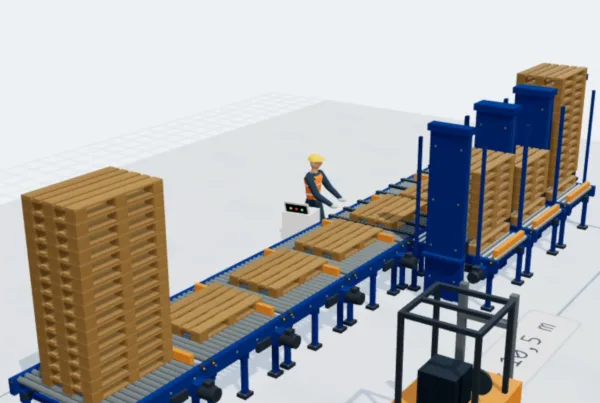
The final station, i.e. the outfeed and stacking of finished pallets, sets the pace for everything before it. At 600 pallets per shift a pallet reaches the stack roughly every 48 seconds, and the operator stacking lifts about 15 tonnes during the shift. In a full cost accounting this station costs about one zloty per pallet. A stacker or robot maintains the same pace throughout the shift, allowing the worker to move to tasks that increase output, such as feeding the line with material. Details and a comparison of the three options are described in the article on the cost of manual pallet stacking.
3. Pallet cost: more pallets per cubic metre of timber
In our range we price timber at about PLN 800 per cubic metre including transport and 22 pallets per cubic metre of blocks. For comparison, one sawmill lists construction timber in its September 2026 price list at from PLN 700 per cubic metre. With our assumptions timber costs about PLN 36.36 per pallet. If the same cubic metre yields 23 pallets, the cost falls to roughly PLN 34.78, a saving of about PLN 1.58 per unit. At 12 600 pallets per month this is close to PLN 20 000. One extra pallet per cubic metre simply means fewer off‑cuts in the bin: a better‑optimised cut, beam lengths matched to the block and deck dimensions, wood grade matched to the construction rather than always the highest grade. It is the same pallet, with the same dimensions and quality, just with less waste. Savings at the expense of quality quickly return in the form of fewer complaints.
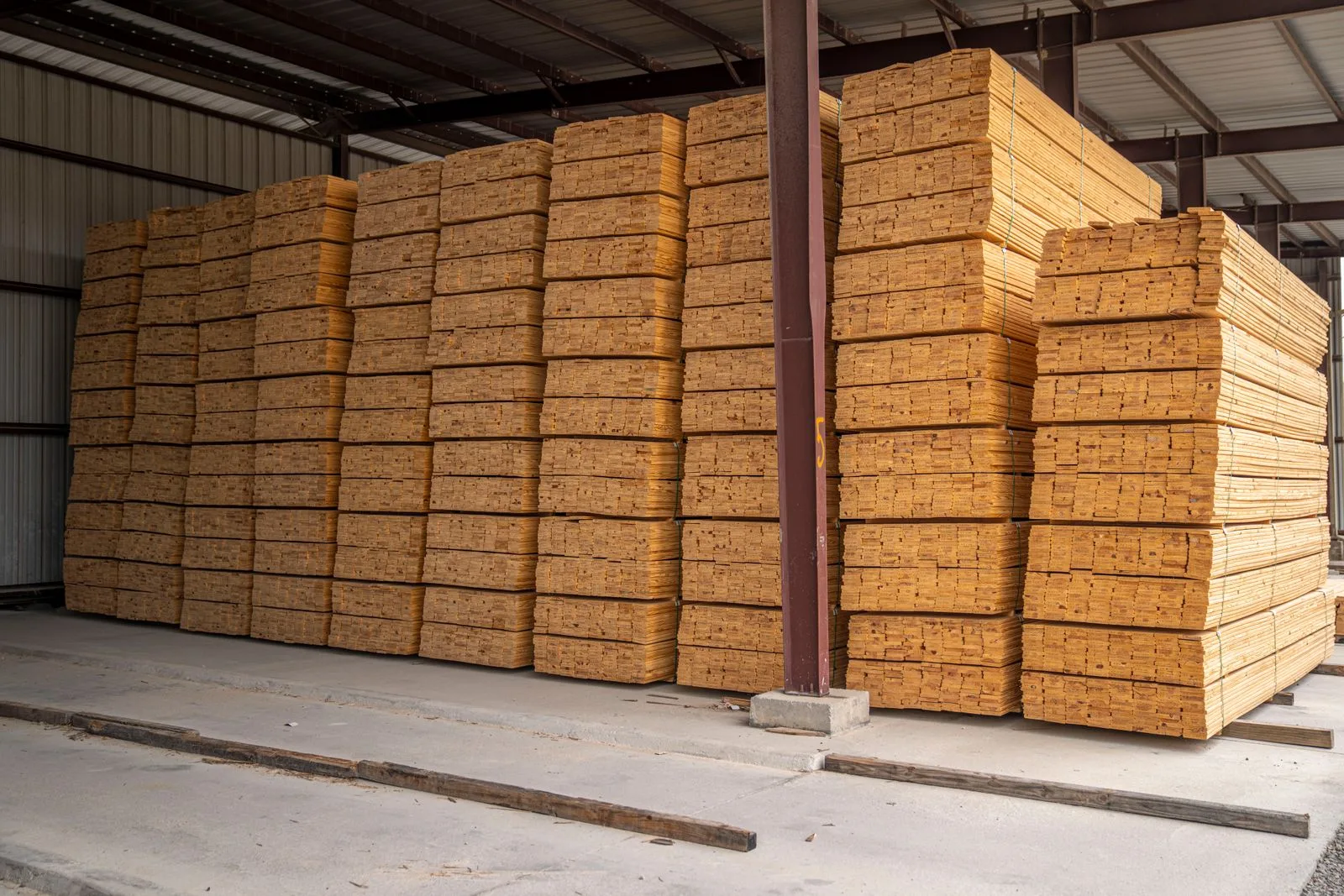
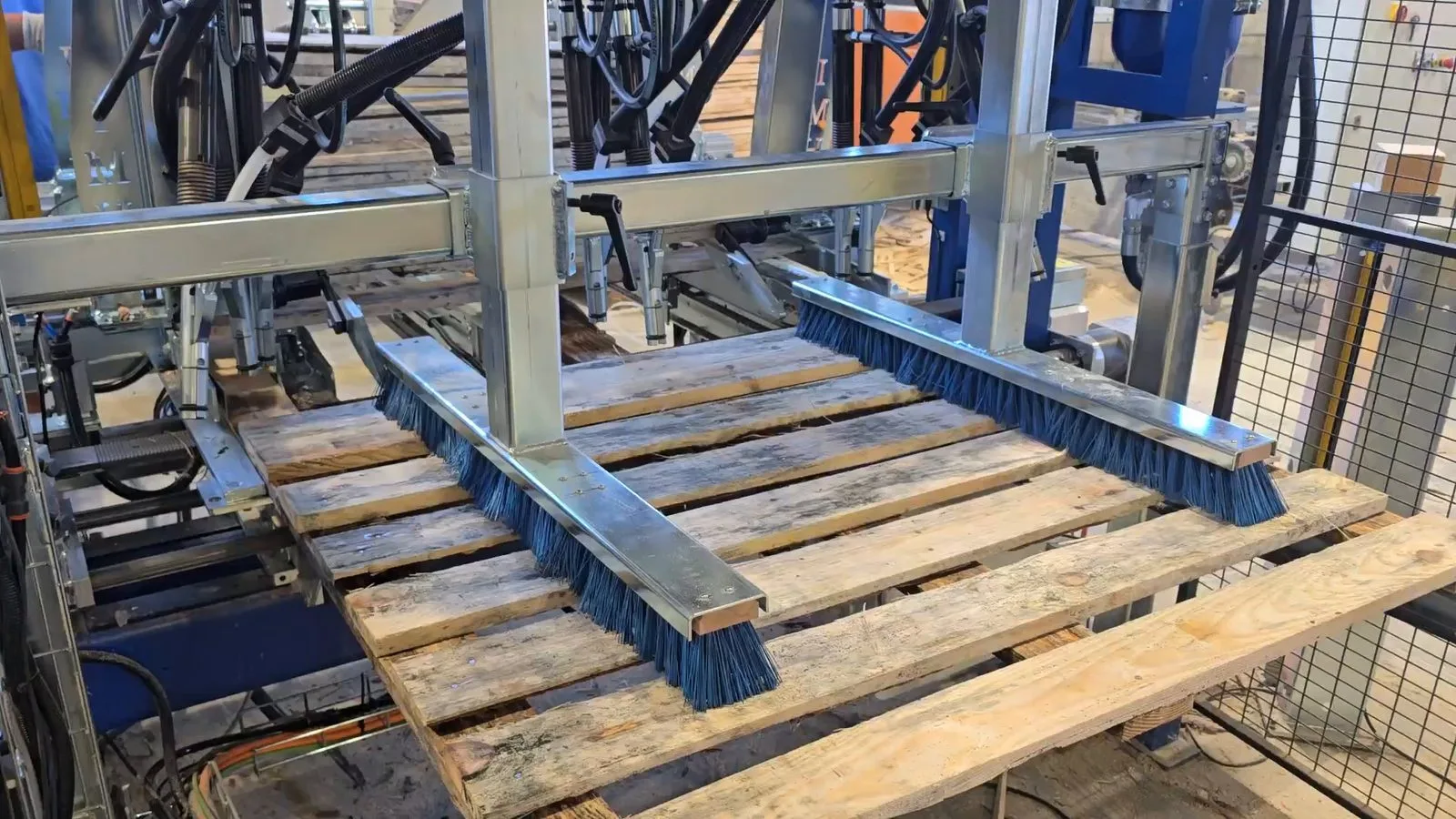
This lever has limits and it is better to state them up front. The proportion of timber cannot be halved. From our experience you can only reduce it from about 80 % to at most seventy-something percent, and that requires daily work on every cut. On IMH lines part of this work is taken over by the optimiser, which according to the manufacturer calculates the beam cut so as to leave as little waste as possible.
The opposite also applies. If a cubic metre realistically yields 21 pallets instead of the assumed 22, timber costs about PLN 38.10 rather than PLN 36.36, and the plant adds roughly PLN 1.74 to each pallet - close to PLN 22 000 per month. No one sees this because the calculation still assumes 22.
You can verify this without any equipment by calculating the timber cost twice. First, from the top: the price of a cubic metre divided by the number of pallets that should be produced from it. Second, from the bottom: all the money paid for timber in a month divided by the number of pallets that actually left the plant. If the two figures differ by more than a few percent, material is being lost - in waste, in an incorrectly accounted delivery or in an outdated price in the spreadsheet.
4. Pallet cost: nails, i.e. about a quarter of a zloty per unit
Coiled nails for drum nailers are more expensive than the same nails loose. In our calculations this is PLN 1.24 versus PLN 0.99 per pallet - a quarter of a zloty. At 12 600 pallets per month this amounts to over PLN 3 000. Loose nails, however, require a machine to feed them, so this method works together with automation rather than instead of it. We compare this in more detail in the cost comparison of manual and automatic production.
5. Downtime: planned maintenance instead of breakdowns during a shift
With 600 pallets per shift the plant produces on average 75 pallets per hour. Each hour of downtime therefore means 75 pallets fewer and the whole crew’s time, which still has to be paid for. At an average labour cost of about £6.50 per pallet this is close to £500 per hour, before we even calculate lost orders. This is not cash that simply returns to the account, because people still receive the same wages. It is time that could be spent on order production or other work instead of waiting. A nailer that has not been inspected always fails at the worst moment, and in continuous operation the seals and valves are replaced every one to two months.
When assembling manually, not just one nailer is idle. With 600 pallets per shift in rotation there are eight to ten, counting larger, smaller and spare units. The spare one makes the biggest difference: when one nailer goes for repair, the station continues operating. The quality of the tool also matters. A branded nailer costs between €350 and €550 and, with proper service, lasts several years, whereas a cheaper substitute under the same conditions can fail in less than a year. A cheap purchase that has to be repeated is rarely cheap.
A scheduled inspection after a shift takes only the technician, not the whole hall. With machines this difference grows, because one stationary machine stops everything behind it. Therefore, for a line it is worth agreeing from day one with service on an inspection schedule and a list of spare parts that should be on site.
6. Working capital: wood purchased to match production rhythm
Wood has to be purchased before the customer pays for the pallets, so cash is tied up in the yard for every metre. In our example plant the wood cost is about £36.40 × 12 600 pallets, i.e. roughly £459 000 per month. Reducing the stock by two working weeks - ten days out of 21 - frees about £220 000 of cash. This is not a saving on the pallet cost, but money that stops sitting on the yard and can be used to repay a working‑capital loan or fund development.
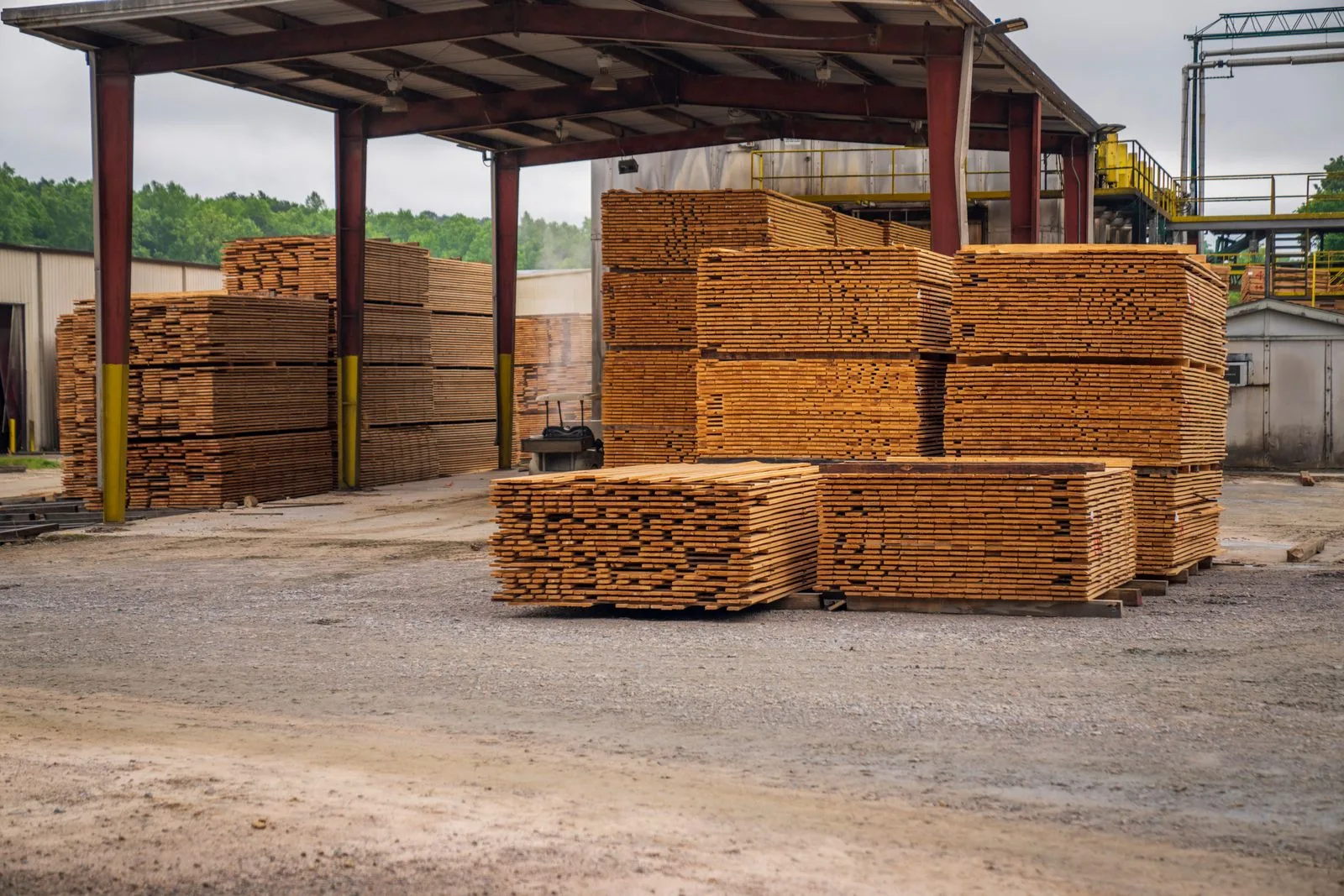
Where does the problem come from? Customers usually pay for pallets after 30 or 60 days, while the wood must be on the yard beforehand. On top of that the price fluctuates throughout the year, and moisture matters: freshly cut timber typically contains 50‑75% water, whereas seasoned wood should be below 20%. When settling per tonne, wet material is therefore noticeably more expensive per unit that actually ends up in the pallet. A plant that buys large quantities as stock therefore pays twice: cash frozen on the yard and material that loses quality while waiting its turn.
The condition is simple: deliveries must be predictable. A shorter stock works with stable suppliers and a known order schedule, and for a non‑standard pallet made for a single order, raw material stock is simply necessary.
7. Fixed costs spread over more pallets
With manual production the fixed costs are low: the hall is on average about £0.90 per pallet, and the nailer with compressor a few pence. Rents for modern warehouse halls in 2026 are from about €3.80 to €5 per square metre per month, roughly £17 to £22, plus operating charges. A hall of around a thousand square metres therefore costs several thousand pounds per month, regardless of whether production runs at full speed. A second shift in the same hall spreads this amount over twice as many pallets and cuts the cost per unit by roughly half.
It is different with machines. The line rate, which at 1 500 pallets per day is about £0.93 per pallet, rises to around £2.31 per pallet at 600 pallets per shift. The same machine, better utilised, produces a cheaper pallet. Therefore when selecting machines we start from the number of pallets the plant can realistically sell, not from the catalogue capacity. Higher production capacity only pays off when the pallets find buyers.
How these methods combine into a single calculation
The methods do not work in isolation. Let’s take three that do not require buying machines: more pallets per metre of wood, less downtime and a shorter wood stock. One extra pallet per metre of wood saves close to £20 000 per month. A shorter wood stock releases a one‑off cash amount of about £220 000. Each hour of downtime avoided means 75 extra pallets and roughly £500 of labour not spent waiting. Four such hours a month amount to about 300 pallets and around £2 000.
Together this adds up to about £22 000 per month and over a quarter of a million pounds per year, plus cash recovered from the yard, part of which is the value of reclaimed labour time rather than money in the bank. The figures are illustrative and will vary for each plant, but the proportions usually remain: wood provides the biggest saving, labour time a little less, and only then do machines multiply the effect of good organisation. A machine placed in chaos accelerates chaos, so the order of investment matters.
There is also an area deliberately omitted from this analysis: shortages, rework and complaints. Every poorly nailed pallet means wood, nails and labour paid twice, both in manual production and on a line. Their cost depends on material and quality control in the particular plant, and is described in a separate article.
What is not worth chasing: electricity for nailing
The compressor power with dryer is, when nailing manually, three or maybe four pence per pallet. Replacing bulbs and hunting for every kilowatt‑hour is a good habit, but not a cost‑saving strategy. Those who start from the meter before they have counted wood waste look for money where there is almost none.
Seven ways in numbers
| Way | Effect in the plant: 600 pallets per shift | What it requires |
|---|---|---|
| 1. Material at the workstation | higher output per person | re‑arranging workstations |
| 2. Automatic stacking | steady end‑of‑production pace, about £1 per pallet workstation cost | stackers or robots |
| 3. More pallets per cubic metre of wood | around £1.58 per pallet, close to £20,000 per month (22 → 23 pallets per m³) | work on cutting plans, possibly optimisers |
| 4. Loose nails | £0.25 per pallet, over £3,000 per month | nail‑feeding machines |
| 5. Planned inspections | 75 pallets and nearly £500 of labour value saved for each hour of downtime avoided | inspection schedule and spare parts on site |
| 6. Wood to match production rhythm | about £220,000 cash with stock reduced by two weeks | predictable deliveries |
| 7. Fixed costs spread over more pallets | line rate from £2.31 to £0.93 per pallet | selling a larger number of pallets |
The figures are based on 2026 prices and our example plant. The method stays the same, but the numbers should be replaced with your own.
Where to start in your own plant
The biggest impact comes from wood and labour time, the smallest from what you see on the meter. To start, just calculate two numbers for yourself. The first is the wood cost calculated from the bottom up: the amount paid for wood in a month divided by the number of pallets that actually left the plant. The second is the number of hours of downtime in the last month. If the first diverges from the cost calculation and the second is not zero, you know which way to start. This is also how we begin the conversation with every plant for which we select machines.
Sources
- MDP Serwis, „What are the real costs of manual pallet production?”: wood price and output, labour, nails, compressor power, hall, nail gun inspections, frozen capital: https://maszynydopalet.pl/jakie-sa-realne-koszty-recznej-produkcji-palet/
- MDP Serwis, „Comparison of manual and automatic production costs”: line rate per pallet at different utilisation
- MDP Serwis, „How much does manual pallet stacking really cost?”: stacking station cost, load lifted per shift
- IMH Machinery AB, machine data sheets (optimiser): https://imhmachinery.se/downloads/
- Knight Frank, „Polish warehouse market, Q1 2026”: big‑box rents EUR 3.80‑5.00/m², operating charge £4‑7/m²: https://content.knightfrank.com/research/3066/documents/pl/rynek-magazynowy-polska-i-kw-2026-12897.pdf
- Rzeczpospolita, „Fewer empty halls. Demand for warehouses rises”, 28.08.2026 (SQM Advisory data, rents about £4‑5 euro/m²): https://www.rp.pl/nieruchomosci/art45058701-coraz-mniej-pustych-hal-popyt-na-magazyny-rosnie
- Tartak Siewierz, „2026 construction timber price list”, prices as of 01.09.2026 (construction timber from £700/m³): https://drewno-tartak.pl/blog/cennik-tarcicy-budowlanej/
- kb.pl, „Fresh wood can have up to 80% moisture”, 22.09.2026 (fresh 50‑75%, target below 20%): https://kb.pl/aktualnosci/ogrod/nowoczesne-metody-suszenia-drewna/
These calculations are a model scenario for an example plant from our range, based on 2026 prices, and not data from a specific customer. Wood price £800/m³, 22 pallets per metre, nail gun prices and durability are our own project and purchase data, not market rates.
We will check it together on your production line. Free of charge.




Napisz komentarz